

Ashwini Vaishnaw Takes Swipe at Rahul Gandhi Over Foxconn Hiring, Cites Make in India Push
Written byTimes India
Share
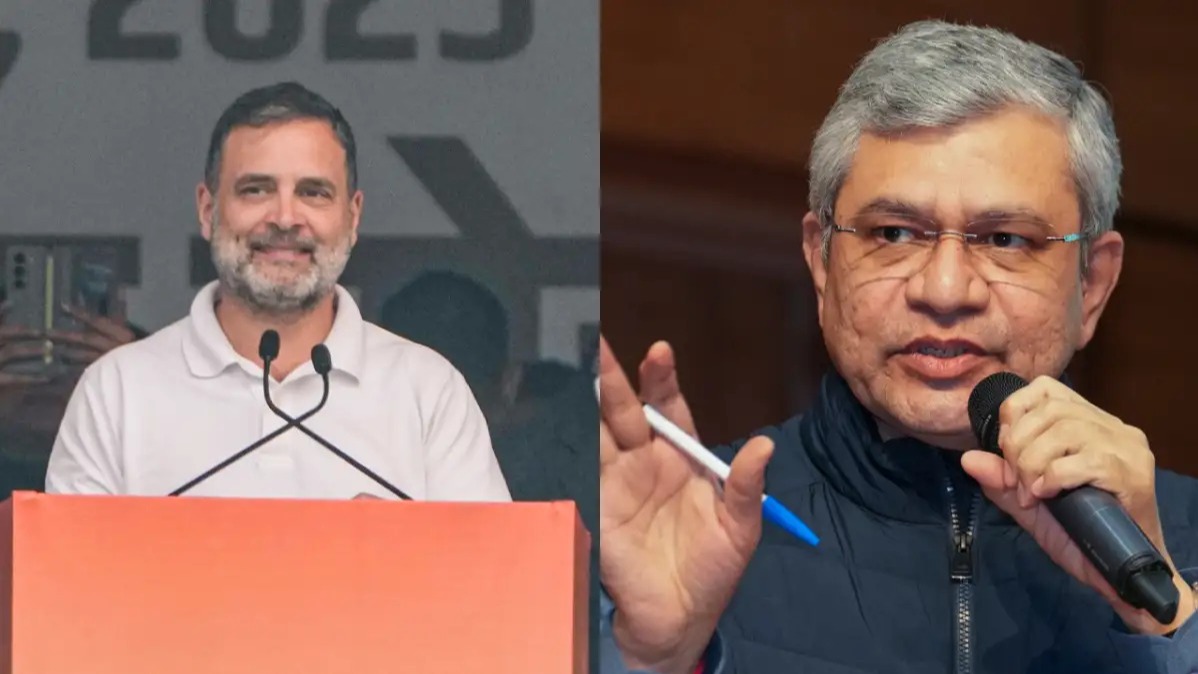
Union Minister for Electronics and Information Technology Ashwini Vaishnaw on Wednesday took a sharp political dig at Congress leader Rahul Gandhi, “thanking” him for acknowledging the role of the Make in India initiative in Foxconn’s hiring plans in the country. The exchange comes amid an ongoing political debate over manufacturing jobs, foreign investments, and employment generation under the Narendra Modi-led government.
The remarks were triggered after Rahul Gandhi commented on Foxconn’s expansion and hiring efforts in India, questioning whether such developments were truly benefiting Indian workers or merely serving corporate interests. Responding to the comments, Vaishnaw said Gandhi’s remarks effectively amounted to an acknowledgement of the success of Make in India, even if unintentionally.
Political Sparring Over Manufacturing Jobs
Taking to social media, Vaishnaw said he “thanks” Rahul Gandhi for recognising that global manufacturing giants like Foxconn are creating jobs in India due to policy reforms and manufacturing incentives introduced by the Modi government. The minister emphasised that Foxconn’s increasing footprint in India reflects growing global confidence in the country as a manufacturing hub.
“This is precisely what Make in India was envisioned to achieve attracting global manufacturers, creating large-scale employment, and building domestic capabilities,” Vaishnaw said. He added that India’s electronics manufacturing ecosystem has expanded rapidly over the past decade, positioning the country as a credible alternative to traditional manufacturing centres.
Foxconn and India’s Manufacturing Push
Foxconn, one of the world’s largest contract electronics manufacturers and a key supplier to Apple, has significantly ramped up its operations in India in recent years. The company has announced plans to expand manufacturing facilities and hire thousands of workers, particularly in states like Tamil Nadu, Karnataka, and Telangana.
Government officials argue that this expansion is a direct result of policy stability, production-linked incentive (PLI) schemes, and infrastructure development under the Make in India framework. According to the Centre, India’s electronics exports have seen steady growth, while domestic value addition has improved across segments such as smartphones, semiconductors, and components.
Rahul Gandhi’s Criticism
Rahul Gandhi, however, has remained critical of the government’s claims. He has repeatedly argued that while foreign companies may be setting up factories in India, the quality of jobs, wages, and long-term employment security remain questionable. Gandhi has also accused the government of prioritising big corporates over small and medium enterprises, which traditionally employ a large share of India’s workforce.
In his remarks on Foxconn, Gandhi sought clarity on whether the hiring push would translate into sustainable employment for Indian youth or remain limited to contractual and low-wage jobs. The Congress leader has consistently called for greater focus on MSMEs, skill development, and labour rights.
Government’s Counter Narrative
Vaishnaw countered these criticisms by highlighting data that suggests millions of jobs have been created directly and indirectly through manufacturing-linked investments. He pointed out that India’s electronics manufacturing sector has grown manifold since 2014, with smartphone production alone crossing record levels.
The minister said that Foxconn’s hiring reflects India’s growing reputation as a reliable, scalable, and cost-effective manufacturing destination. He also underlined the role of skill development programmes that aim to ensure Indian workers are equipped for advanced manufacturing roles.
Broader Political Implications
The exchange underscores the wider political battle over economic narratives ahead of upcoming elections. For the BJP, Make in India remains a flagship initiative symbolising job creation, self-reliance, and global integration. For the Congress, the focus remains on questioning the distribution of benefits, employment quality, and inclusivity of growth.
Political analysts note that debates around companies like Foxconn are likely to intensify, as manufacturing and employment remain key voter concerns. While the government points to investment figures and export growth, the opposition continues to demand accountability on job quality and long-term economic impact.
Ashwini Vaishnaw’s pointed response to Rahul Gandhi highlights how economic policy and employment narratives have become central to political discourse. Foxconn’s expansion in India may be widely seen as a win for Make in India, but the debate over who truly benefits from such investments workers, corporates, or the broader economy remains far from settled.
As India pushes ahead with its ambition to become a global manufacturing powerhouse, political scrutiny over jobs, wages, and inclusive growth is likely to remain firmly in the spotlight.